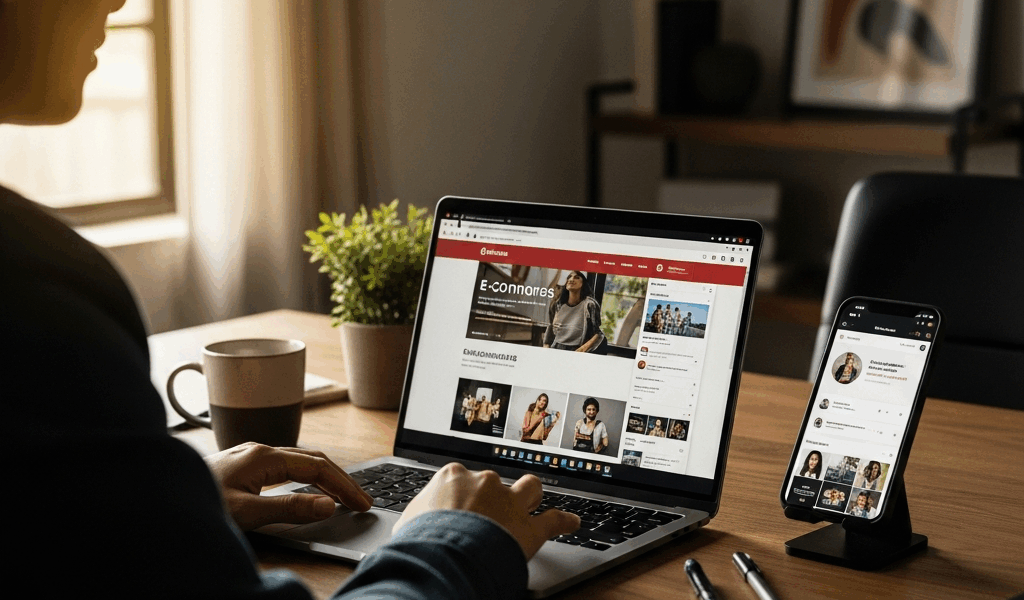
Someone told you that every business needs a website. Someone else told you that social media is all you need in 2026. Both are wrong — or rather, both are right depending on where your business actually is right now. The honest answer is not always “build a website immediately” and pretending otherwise loses the trust of every business owner who is doing just fine with an Instagram page and a phone number. Here is when social media alone genuinely works, when it stops working, and what the actual triggers are for building a real website.
When Social Media Alone Actually Works
If your business runs entirely on word-of-mouth and repeat customers, a website may not be urgent. A hair stylist with a full book from Instagram DMs and referrals does not need a website to survive. Neither does a food truck that posts daily locations on Instagram Stories, a freelance photographer who gets every client through a referral or an Instagram portfolio, or a personal trainer whose entire client base comes from gym connections and social proof on TikTok.
If you are operating on a marketplace platform — Upwork, Fiverr, Etsy, Amazon — your platform profile IS your web presence, at least in the early stages. These platforms have their own search engines, their own trust signals (reviews, ratings, sales volume), and their own traffic. Duplicating all of that on a standalone website when you have five clients is a poor use of your limited time and money.
The pattern: social media alone works when your discovery channel is personal connection, referral, or platform-specific search — not Google. If nobody is Googling what you do, a Google-optimized website is solving a problem you do not have.
When You Absolutely Need a Website
The moment someone Googles your business name and finds nothing, you have a credibility problem. A potential client who was referred to you will Google your name before reaching out. If the only result is a Facebook page with a pixelated cover photo last updated in 2024, that client is questioning the referral. A website — even a simple one — signals that you are a real, established business.
You need a website if you want to rank for local service searches. “Plumber near me,” “wedding photographer in Denver,” “tax accountant Austin” — these searches happen millions of times a day, and social media profiles rarely rank for them. A properly optimized website with local SEO can capture this traffic. Social media cannot.
You need a website if you sell products online. Instagram Shopping and Facebook Marketplace work for casual selling, but for a real e-commerce operation — inventory management, shipping integration, customer accounts, return policies — you need Shopify, WooCommerce, or a similar platform on your own domain.
You need a website if your average sale exceeds $500. The higher the price, the more research the buyer does before committing. That research includes visiting your website, reading about your process, checking testimonials, and verifying that you are legitimate. A social media page alone does not satisfy the due diligence that high-ticket buyers perform.
The Algorithm Risk Nobody Talks About
Here is the part that social-media-only business owners need to hear clearly: you do not own your social media audience. Instagram can change its algorithm tomorrow and cut your organic reach by 80 percent — this is not hypothetical, it happened in 2016 and again in 2022. Facebook page organic reach dropped from 16 percent to under 5 percent over a few years. TikTok faces potential bans in multiple countries.
Real businesses have lost real revenue overnight because a platform decided to change how it distributes content. A restaurant in Portland built its entire customer base through Instagram — 15,000 followers, consistently full tables on weekends. When Instagram shifted to prioritizing Reels over static posts, their reach collapsed. They had no email list, no website, and no way to contact their followers directly. They rebuilt, but it took months and cost thousands in paid ads to recover.
A website is the only digital asset you fully own and control. No algorithm decides who sees your site. No platform can disable your account. Your domain, your hosting, your content, your customer data — all under your control. This does not mean social media is bad. It means social media should drive traffic TO your website, not replace it.
The Minimum Viable Website
You do not need a 20-page website with a blog, a resource library, and a custom portal. For most small businesses starting out, a single-page site with five elements is enough:
Your business name and what you do — in plain language, not marketing jargon. Your location or service area. How to contact you (phone, email, or booking link). Three testimonials from real clients. Links to your social media profiles.
That is it. A landing page that establishes credibility when someone Googles your name. It takes about 2 hours to build on Carrd ($19/year) or Squarespace Personal ($16/month). You do not need a developer. You do not need to learn code. You need an afternoon and a credit card.
This minimum viable website solves the credibility gap without the time and cost commitment of a full site. When your business grows to the point where you need booking systems, e-commerce, or content marketing — that is when you upgrade.
The Smart Sequence
Stage 1 — Validation: Launch on social media. Build an audience. Get your first 10 paying customers. Prove that people want what you sell. Zero website needed at this stage. Your time is better spent on the product and the customers.
Stage 2 — Credibility: Once people start Googling your business name (you will know because they tell you “I looked you up”), build a minimum viable website. One page, your basics, done in an afternoon. Cost: under $200 per year.
Stage 3 — Growth: When you want to attract NEW customers who do not already know your name — through local SEO, content marketing, or paid ads — invest in a proper multi-page website with SEO optimization. This is where a developer or a platform like WordPress starts making sense.
Stage 4 — Scale: E-commerce, membership portals, custom integrations, CRM connections. This is the full website build that costs $3,000 to $15,000 and requires professional help. Do not start here. Grow into it.
The mistake most business owners make is building for Stage 4 when they are still in Stage 1. Build what you need now, and upgrade when the business demands it — not because someone told you that you need a website.




Stay in the loop
Get the latest web sme updates delivered to your inbox.