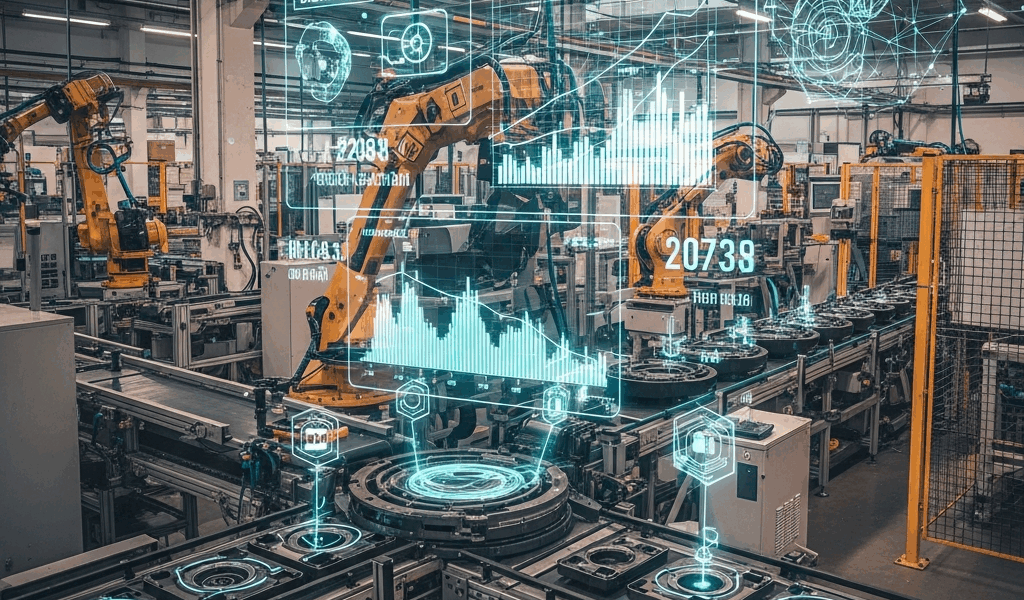
A manufacturing digital twin is a synchronized virtual model used to represent, diagnose, predict, or optimize a physical asset, process, cell, line, or production system. The valuable part is not a 3D image. It is a validated relationship between the model, real operating data, a decision, and a measurable manufacturing outcome.
This guide examines six practical manufacturing use cases and shows how to evaluate whether a “case study” demonstrates a credible twin or merely a dashboard, simulation, or marketing visualization.
What makes a manufacturing digital twin credible?
NIST describes digital twins as synchronized virtual models and emphasizes requirements, interoperability, trustworthiness, verification, validation, and uncertainty quantification. A useful manufacturing twin has:
- a defined physical or process scope;
- a model of relevant structure, state, behavior, and relationships;
- controlled data flows that update or calibrate the model;
- a specific decision or operational action;
- validation showing when outputs are accurate enough for that decision;
- known uncertainty, assumptions, limits, and failure behavior;
- measured benefit compared with the previous process.
A one-time simulation can be valuable, but it is not automatically a digital twin. A live sensor dashboard is not automatically a twin either. The model and synchronization must support the claimed analysis or decision.
Case 1: machine condition and predictive maintenance
The twin combines equipment structure, operating state, telemetry, maintenance history, and an analytical or physical model to estimate degradation or detect abnormal behavior. The decision may be when to inspect, change a component, adjust operating limits, or schedule downtime.
Evidence to require
- defined failure modes and the sensors capable of observing them;
- time synchronization, missing-data behavior, and calibration records;
- precision, recall, warning time, and false-alarm cost on unseen conditions;
- a workflow showing who receives the finding and what action follows;
- comparison with preventive maintenance or existing condition monitoring.
A model that predicts a vague “health score” without an actionable threshold, uncertainty, or maintenance response may add little operational value.
Case 2: production flow and throughput
A line or factory twin models machines, buffers, routing, changeovers, labor, material movement, downtime, and schedules. Teams can test a sequence, staffing level, batch size, or maintenance window before changing production.
Validate cycle-time and downtime distributions rather than matching only average throughput. A model can reproduce the average while missing the queues and rare events that create late orders. Measure output, work in process, lead time, constraint utilization, schedule adherence, and sensitivity to uncertain inputs.
Case 3: quality prediction and process control
A process twin relates materials, settings, environment, equipment condition, and in-process signals to quality outcomes. It can help identify influential variables, predict out-of-spec production, or recommend a parameter window.
Separate correlation from control authority. Validate across materials, tools, operators, seasons, and product variants. Record the risk of a false pass and false reject. Human approval, change limits, and rollback may be necessary before a recommendation can adjust a production process.
Case 4: virtual commissioning
A machine, robot cell, or controls twin lets engineers test PLC logic, robot paths, interlocks, timing, and exception behavior before physical commissioning. The goal is to discover integration and sequence defects earlier and reduce unsafe or expensive floor testing.
Useful test cases
- normal startup, production, controlled stop, and restart;
- sensor failure, late signal, jam, missing part, and emergency stop;
- robot reach, collision zones, cycle time, and handoff synchronization;
- operator modes, maintenance modes, and access interlocks;
- version alignment between virtual logic and deployed control code.
The virtual environment does not replace required physical safety validation. Document which behavior the model can and cannot represent.
Case 5: robot workcells and human interaction
A workcell twin can represent robot motion, fixtures, tools, parts, safety zones, material presentation, and operator tasks. NIST catalogs manufacturing research on robot-workcell data requirements and processes involving human interactions.
Human work introduces variability that a deterministic animation may hide. Use observed task distributions, ergonomic constraints, interruptions, and alternate sequences. Protect worker privacy and avoid using a low-fidelity model to impose unrealistic standards.
Case 6: product lifecycle and the digital thread
A product or process twin can connect engineering definition, manufacturing configuration, inspection, as-built records, field performance, service, and design feedback. The challenge is traceability: model versions, part serials, software, process parameters, quality records, and maintenance events must refer to the correct configuration.
NIST’s manufacturing work includes reference implementations around ISO 23247 and digital-thread data flow. Begin with one lifecycle question—for example, which process conditions explain a recurring field failure—rather than attempting to unify every system at once.
Digital twin case-study scorecard
| Question | Strong evidence |
|---|---|
| What is twinned? | Named asset/process boundary and lifecycle stage |
| What is modeled? | Relevant structure, behavior, state, relationships, and assumptions |
| How is it synchronized? | Sources, cadence, quality, identity, time, lineage, and error handling |
| What decision changes? | Named owner, threshold, action, and fallback |
| How is it validated? | Test cases, independent data, uncertainty, limits, and change control |
| What improved? | Baseline and measured production, quality, cost, risk, or time outcome |
Implementation sequence for a manufacturer
- Select one costly decision with a known owner and baseline.
- Define the twin boundary, required fidelity, update rate, and acceptable uncertainty.
- Inventory asset identities, sensors, records, engineering models, and data gaps.
- Build the smallest model that can support the decision.
- Verify software and data pipelines; validate outputs against physical evidence.
- Run in advisory mode and compare recommendations with actual outcomes.
- Integrate with the operating workflow, permissions, alerts, and change control.
- Monitor model drift, sensor health, exceptions, benefit, and ongoing cost.
A credible twin also depends on governed data pipelines and measurable decisions. Use our data analytics implementation guide to connect ownership, quality, metrics, and operating workflow. This page is the consolidated evidence and use-case guide for the site’s former introductory Digital Twin articles.


Stay in the loop
Get the latest web sme updates delivered to your inbox.