Sentiment Analysis
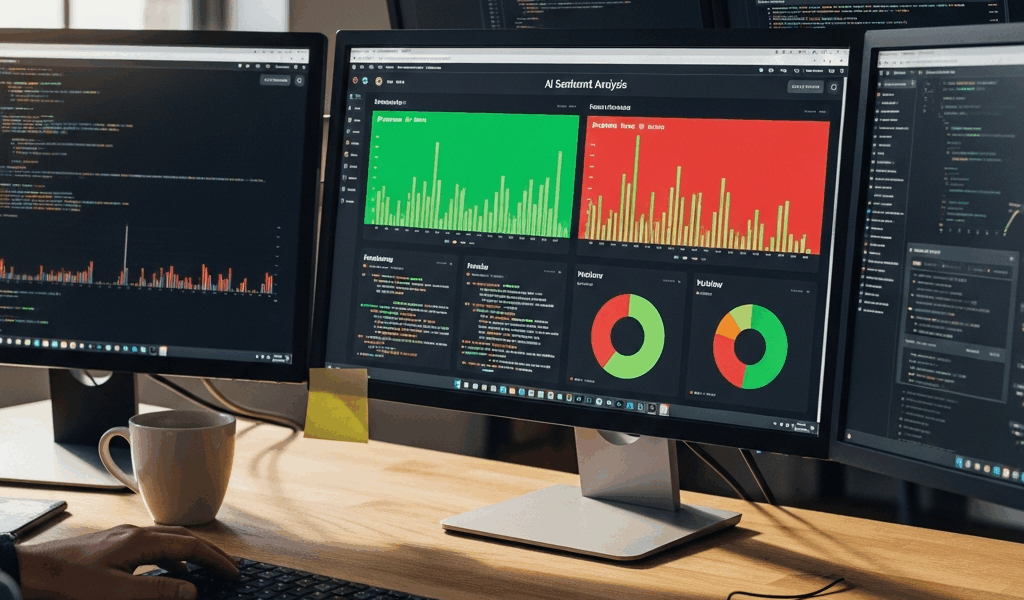
Sentiment analysis has gotten complicated with all the buzzwords and vendor pitches flying around. At its core, though, it’s straightforward: you feed text into a system and it tells you whether the writing is positive, negative, or neutral. The field sits at the intersection of natural language processing, computational linguistics, and statistical analysis — and when it works well, it’s genuinely useful for understanding what people think at scale. When it doesn’t work well, you get confidently wrong classifications that cost real money.
How Sentiment Analysis Works
Everything starts with preprocessing — cleaning up the raw text so the model has something useful to work with. Tokenization splits text into individual words or phrases. Stemming reduces words to their root forms (so “running,” “runs,” and “ran” all become “run”). Lemmatization goes a step further by grouping inflected forms intelligently, using the word’s actual dictionary form rather than just chopping off suffixes.
Once the text is cleaned up, you extract features — identifying which parts of the text actually carry sentiment signal. The classic approach is bag-of-words, which just counts word occurrences. TF-IDF (term frequency-inverse document frequency) improves on this by weighing words that are distinctive to a document more heavily. Modern approaches use word embeddings like Word2Vec and GloVe that capture semantic relationships between words — so the system understands that “excellent” and “outstanding” are closer in meaning than “excellent” and “terrible.”
Types of Sentiment Analysis
The simplest version is polarity analysis: positive, negative, or neutral. That’s useful for a high-level read on customer feedback but misses nuance. Emotion detection goes deeper, identifying specific feelings — happiness, sadness, anger, fear, surprise. Aspect-based sentiment analysis gets more granular still, identifying sentiment toward specific elements within the text. A restaurant review might be positive about the food but negative about the service; aspect-based analysis catches that distinction where polarity analysis would just average it out. Fine-grained analysis maps sentiment to a scale — typically 1 to 5 — giving you ratings rather than categories.
Applications
Probably should have led with this section, honestly. Real-world use cases make the technology click better than definitions do.
Businesses use sentiment analysis to monitor what customers actually think. Scanning social media, reviews, and support tickets at scale gives you a pulse on customer sentiment that manual reading can’t match. Financial firms apply it to news articles and social media to predict market movements — when sentiment around a company shifts negative before earnings, there’s often signal in that noise. Political campaigns and government agencies track public opinion on policies and candidates in near real-time.
In customer service, sentiment analysis can automatically flag the angriest support tickets for priority handling — because the customer writing in all caps with three exclamation points probably shouldn’t wait in the same queue as someone asking a routine question. Marketing teams use it to measure brand perception and track how campaigns land across different audiences.
Tools and Libraries
The ecosystem is mature enough that you don’t need to build everything from scratch:
- NLTK (Natural Language Toolkit): The granddaddy of Python NLP libraries. Comprehensive, well-documented, and the starting point for most people learning NLP. Not the fastest option for production workloads, but unbeatable for learning and prototyping.
- TextBlob: Built on top of NLTK with a simpler API. If you just need basic sentiment analysis and don’t want to spend a week reading documentation, TextBlob gets you there with a few lines of code.
- VADER: Specifically designed for social media text. It handles slang, emojis, and the kind of informal writing that makes traditional NLP tools fall apart. If you’re analyzing tweets or Reddit comments, VADER is usually a better starting point than general-purpose tools.
- Stanford NLP: A comprehensive suite from Stanford’s NLP research group. More academic in orientation but powerful and well-maintained.
- Google Cloud Natural Language: A fully managed cloud service that handles the infrastructure for you. You send text, you get sentiment scores back. The tradeoff is cost and dependency on Google’s API.
- IBM Watson: Advanced text analysis including sentiment and tone analysis. The enterprise sales pitch can be heavy, but the underlying technology is solid for production deployments.
Challenges and Limitations
Here’s where things get honest. Language is messy, and sentiment analysis handles the messy parts poorly:
Sarcasm is the classic failure mode. “Oh great, another meeting” is negative despite containing a positive word. Irony, context-dependent meaning, and cultural references all create similar problems. Slang evolves faster than training data, and what means one thing in one community means something entirely different in another.
Mixed sentiments within a single piece of text are another headache. A product review that says “the camera is amazing but the battery life is terrible” contains both positive and negative sentiment. Simple polarity models get confused; aspect-based models handle this better but require more sophisticated training. And all of these models need continuous retraining as language evolves — a model trained on 2020 data will miss slang and cultural references that appeared in 2024.
Metrics for Evaluation
Measuring how well your sentiment analysis actually works requires the right metrics. Accuracy — the percentage of correct predictions — is the obvious starting point but can be misleading if your dataset is unbalanced (if 90% of reviews are positive, a model that always predicts “positive” gets 90% accuracy while being completely useless). Precision tells you what fraction of your positive predictions were actually positive. Recall tells you what fraction of actual positives you caught. The F1 score balances precision and recall into a single number, which is usually the most informative metric for comparing models.
Ethical Considerations
Analyzing what people write raises legitimate concerns that are worth thinking about before deploying anything. Privacy is the obvious one — scraping and analyzing personal communications, even public social media posts, has implications that “technically legal” doesn’t fully address. Bias in training data creates biased models, and biased models make unfair classifications. If your training data underrepresents certain dialects or cultural communication styles, your model will systematically misclassify those groups. Transparency about how sentiment analysis is being used and what decisions it informs matters for maintaining trust with the people whose text you’re analyzing.
Future Trends
Transformer architectures have already dramatically improved sentiment analysis accuracy, and that trajectory continues. Models like BERT and its successors understand context in ways that bag-of-words approaches never could, catching sarcasm and nuance that tripped up earlier systems.
Multimodal sentiment analysis — combining text with audio tone, facial expressions, and video content — is the next frontier. Understanding that someone says “fine” through clenched teeth conveys different sentiment than a relaxed “fine” requires more than text analysis. As compute costs drop and multimodal models mature, this integrated approach will likely become standard for applications where accuracy really matters.



Stay in the loop
Get the latest web sme updates delivered to your inbox.