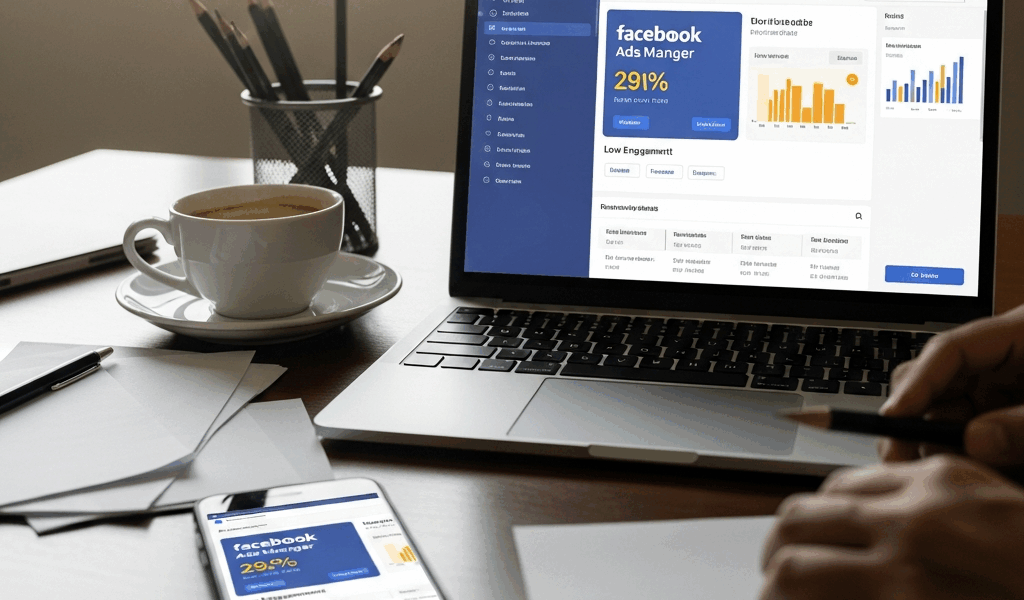
Why Your Facebook Ads Are Not Getting Results
Facebook advertising has gotten complicated with all the conflicting advice flying around. Boost this post. Target that interest. Use video. Use carousels. Meanwhile, you just spent $50 — maybe $200 — on a campaign for your plumbing service or your new product line, checked back the next morning, and found three clicks and zero sales.
As someone who torched their first $150 Facebook budget on a local service campaign with absolutely nothing to show for it, I learned everything there is to know about why these ads fail. Today, I will share it all with you.
Probably should have opened with this section, honestly — most beginners fail for the same five reasons, and every single one of them is fixable once you know where to look. So, without further ado, let’s dive in.
Your Ad Is Running But Nobody Is Seeing It
This one catches new advertisers completely off guard. The campaign shows “Active.” The budget is spending. But the actual reach? Embarrassing. Maybe 47 impressions on a $50 spend.
Three things kill visibility before your ad even gets a fair shot: audience too narrow, audience too broad, or your ad is stuck in review. That’s it. One of those three.
Open Ads Manager and click into your campaign, then find the “Delivery” column. Anything other than “On Track” means your ad isn’t running normally. Facebook sometimes throttles delivery while reviewing creative — this process can drag on for 48 hours or longer. If your reach sits under 1,000 on a $10 daily budget after two full days, something is genuinely wrong.
Next, look at audience size. Meta shows estimated audience size in the right-hand column of your ad set targeting screen. For beginners, 50,000 to 500,000 people is the sweet spot. I’m apparently a chronic over-targeter and stacking interests never works for me, while simple geographic targeting almost always delivers. Don’t make my mistake.
If you targeted “plumbers interested in lead generation” in a town of 100,000 people, your eligible audience might be 800 people. That’s suffocating. Strip out the interest layer entirely. Start with geography first — everything else comes later.
People Are Seeing It But Not Clicking
Impressions climbing. Two thousand views. Five thousand. But the click-through rate is completely flat.
Your creative is the problem. Not always the design — usually the message.
But what is a good CTR? In essence, it’s the percentage of viewers who actually click. But it’s much more than that — it’s a signal of whether your message resonates with the right people or misses them entirely. Check your “CTR (All)” column in Ads Manager. For cold audiences, anything under 0.5% is a red flag. Most people who see your ad don’t think it’s worth a single click.
Ads that fail tend to look exactly like ads. Stock photo of a smiling person in a blazer. Generic headline reading “Contact Us Today.” Vague CTA with zero reason to click. I ran one of these for a client in early 2022 — a $75 spend that generated four clicks, all of which were probably accidental.
The fix is concrete. Lead with the problem your customer actually has, not the service your business sells.
Bad: “Premium Accounting Services for Small Businesses”
Better: “Spending 10+ hours a week on bookkeeping? We cut that down to 2.”
One signals a feature. The other signals relief. That’s what makes specific, problem-first messaging endearing to us small business owners — it actually speaks to us.
Use a real photo or video. Show the product being used. Show the before-and-after. Avoid anything that screams design agency. The image should feel like it came from a customer’s phone. And get specific about the offer — not “Sign Up Now” but “Get Your Free 15-Minute Consultation” or “Download Our Price List.” Specificity removes friction because the person knows exactly what happens when they click.
People Click but Nothing Happens After
Traffic flowing. Ads Manager showing 120 clicks. Then silence. No form fills. No calls. No orders.
The destination is lying to your traffic.
Frustrated by slow mobile load times, I once sent ad traffic to a homepage that took eight full seconds to load on 4G. Half the clicks vanished before the page even rendered. That was around $40 of completely preventable waste on a $90 campaign.
Test your destination URL on your phone right now. Use 4G, not WiFi. Does it load inside three seconds? Can you find the actual offer within two taps? If the ad promises a free consultation but the landing page opens on three paragraphs of company history with a form buried at the bottom, people are leaving.
Also — and this sounds almost too obvious — make sure the URL actually works. Broken destination links on live ads are more common than you’d think. Click your own ad. Verify the page loads and matches what you promised.
No dedicated landing page? Use a Facebook lead form instead of sending traffic off-site. These tend to convert better for beginners anyway, since the person never leaves the platform they’re already comfortable in.
You Are Targeting the Wrong People
Targeting feels like a superpower the first time you see it. Interests. Behaviors. Job titles. Income brackets. Relationship status. The options go on for pages.
This freedom breaks most new campaigns.
Too broad and you’re paying to reach people who will never buy. Too narrow and Facebook can’t find enough eligible people, so it either stops running or burns budget on poor matches. Neither outcome is useful.
The beginner sweet spot: geography and demographics only. Running ads in Portland? Target Portland and the surrounding 25 miles. Ages 25 to 65. Exclude existing customers if you have that data. That’s your entire targeting setup. Let Facebook’s algorithm figure out who actually engages within that pool — it’s surprisingly good at this when you give it room to work.
If you have a customer email list, upload it as a custom audience first. Then ask Facebook to find similar people — that’s a lookalike audience. This new idea took off several years later in the platform’s history and eventually evolved into one of the most reliable targeting tools advertisers know and use today. For small businesses, it almost always outperforms cold interest targeting because it’s built from real behavior, not guesses.
“Advantage+ Audience” might be the best option eventually, as scaling campaigns require broader reach. That is because the algorithm needs volume and historical data to optimize properly. But on a $200 test budget with a brand-new campaign? Turn it off. You need control first, optimization later.
What to Actually Do Before Running Your Next Ad
While you won’t need a professional media buyer or a $5,000 monthly retainer, you will need a handful of basics locked in before you spend another dollar. First, you should run through this checklist — at least if you want your next campaign to teach you something useful.
- Confirm your Facebook pixel is installed and firing correctly, or skip it entirely and use lead forms if the technical setup feels overwhelming right now.
- Set a realistic test budget. Five dollars a day for seven days is $35 of actual learning — not failure, data.
- Run one ad variation at a time so you know what actually moved the needle.
- Check results after three full days minimum, not three hours. Facebook’s learning phase needs time.
- Click your own destination URL on 4G and time how long it takes to load. Three seconds is the ceiling.
Your first campaign probably won’t be your best one. That’s not a personal failure — that’s just how the process works. Save what performed, cut what didn’t, and run the next test smaller and smarter. Within three or four cycles, you’ll have real signal about what actually resonates with your customers. That signal is worth more than any single campaign result.

Stay in the loop
Get the latest web sme updates delivered to your inbox.