Choosing the Right AWS Region for Your Workload
AWS region selection has gotten complicated with all the new region launches, pricing changes, and vendor sales calls flying around. As someone who has helped companies pick regions for workloads ranging from static websites to multi-region financial platforms, I learned everything there is to know about the tradeoffs that actually matter. Today, I will share it all with you.
AWS is structured around the concept of regions — separate geographic areas, each containing multiple isolated data centers called Availability Zones. Picking the right region affects your latency, your costs, your compliance posture, and your disaster recovery options. It is one of the first architectural decisions you make and one of the hardest to change later.

Where the Regions Are
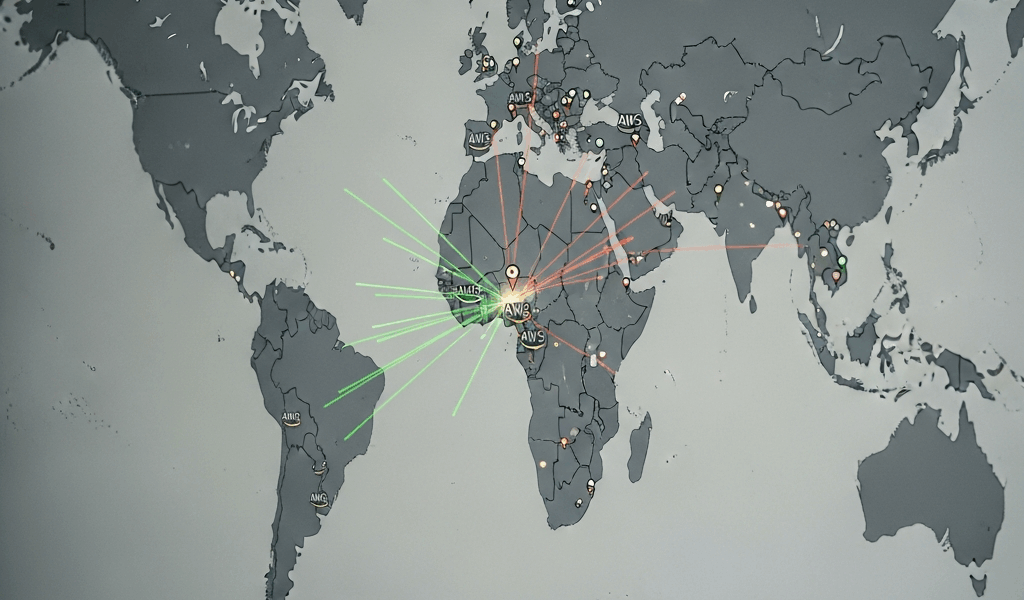
AWS regions span the globe, and the distribution keeps expanding:
- North America: US East (N. Virginia), US West (Oregon), US East (Ohio), US West (N. California), and Canada (Central). Virginia is the oldest and cheapest region, which is why it ends up as the default for so many accounts.
- Europe: EU (Ireland), EU (Frankfurt), EU (London), EU (Paris), EU (Stockholm), and others. Ireland launched early and carries the most service availability in Europe.
- Asia Pacific: Tokyo, Singapore, Sydney, Mumbai, Seoul, and more. Tokyo and Singapore tend to be the go-to choices for companies serving Asian markets.
- South America: São Paulo is the primary region, though it carries a price premium compared to North American regions.
- Middle East and Africa: Bahrain and Cape Town serve these areas. Both are relatively newer additions.
Availability Zones and Why They Matter
Probably should have led with this section, honestly. Each region contains multiple Availability Zones, and each zone is a physically separate data center with independent power, cooling, and networking. They are connected via low-latency fiber but separated enough that a fire, flood, or power failure at one zone does not take down the others.
This matters because distributing your application across multiple AZs within a region gives you high availability without the complexity and cost of multi-region deployment. Most companies start here before even thinking about cross-region architecture.
Latency: The Primary Driver
The physical distance between your users and your chosen region determines baseline latency. There is no software optimization that overcomes the speed of light across 3,000 miles of fiber. If your primary users are in Germany, running from Virginia adds 80 to 100 milliseconds of round-trip latency that Frankfurt would eliminate.
That’s what makes region selection endearing to us infrastructure people — it is a decision with clear, measurable impact. You can test it yourself using AWS latency tools or simple ping tests from user locations to different regions.
Compliance and Data Residency
Some regulations require data to physically reside in specific geographies. GDPR has data residency implications for EU citizen data. Canadian PIPEDA has requirements for certain data types. Financial services regulations in various countries mandate in-country data storage.
AWS regions help meet these requirements because you control exactly where your data lives. Using EU regions for European user data, for example, addresses GDPR data residency concerns directly.
Cost Differences Between Regions
Pricing varies between regions, sometimes significantly. US East (Virginia) is consistently among the cheapest. São Paulo and some Asian regions carry premiums of 20 to 40 percent over Virginia pricing for identical services. Use the AWS Pricing Calculator to estimate costs before committing to a region.
Data transfer costs between regions add up quickly. Intra-region transfers are free or cheap. Cross-region transfers are not. Architect your data flows to minimize cross-region movement, and when you must transfer data between regions, batch it during off-peak windows if latency allows.
Disaster Recovery Strategies
Multi-region deployment provides the highest level of resilience. Common patterns include active-active (running the full application in two or more regions simultaneously) and active-passive (primary region handles traffic while a secondary region maintains warm standby). Active-active costs more but provides near-zero recovery time. Active-passive costs less but recovery involves failover time.
AWS provides tools like cross-region replication for S3 and RDS, Global Accelerator for traffic management, and Route 53 for DNS-based routing between regions.
Service Availability Varies
Not every AWS service launches in every region simultaneously. New services often debut in Virginia or Oregon before rolling out globally. If your architecture depends on a specific service, verify it exists in your target region before committing. The AWS regional services page maintains current availability.
Practical Recommendations
- Start with latency: Pick the region closest to your primary users.
- Check compliance: Verify your region choice satisfies regulatory requirements.
- Validate services: Confirm every service your application needs is available in the region.
- Estimate costs: Run pricing comparisons between candidate regions.
- Plan for growth: Consider adding a second region for disaster recovery as your application matures.
Region selection is foundational. Get it right early and your infrastructure scales naturally. Get it wrong and you face expensive migration work later. Take the time to evaluate your actual requirements against AWS’s regional offerings before launching anything into production.


Stay in the loop
Get the latest web sme updates delivered to your inbox.